
Traditionally, the first days of racing in the Route du Rhum – Destination Guadeloupe are synonymous with a head-on collision with the autumnal weather systems… and the related stress for the sailors. Storm Austen, which hammered the race village in Saint Malo last week, provided an insight into what the weather conditions typically have in store at this time of year. Fortunately, this is a far cry from what is currently forecast for this 13th edition! Indeed, a powerful anticyclone sitting over the British Isles is barring the way to a vast depression parked up off Greenland. At the same time, the very long front associated with this depression is extending its grip as far as the latitude of the Canaries, totally disrupting the formation of the trade wind. This relatively atypical weather situation for the season is set to give rise to a strategy that will throw the Route du Rhum statistics into a spin.
31.10.2026
An atypical course and a superlative start to the race.
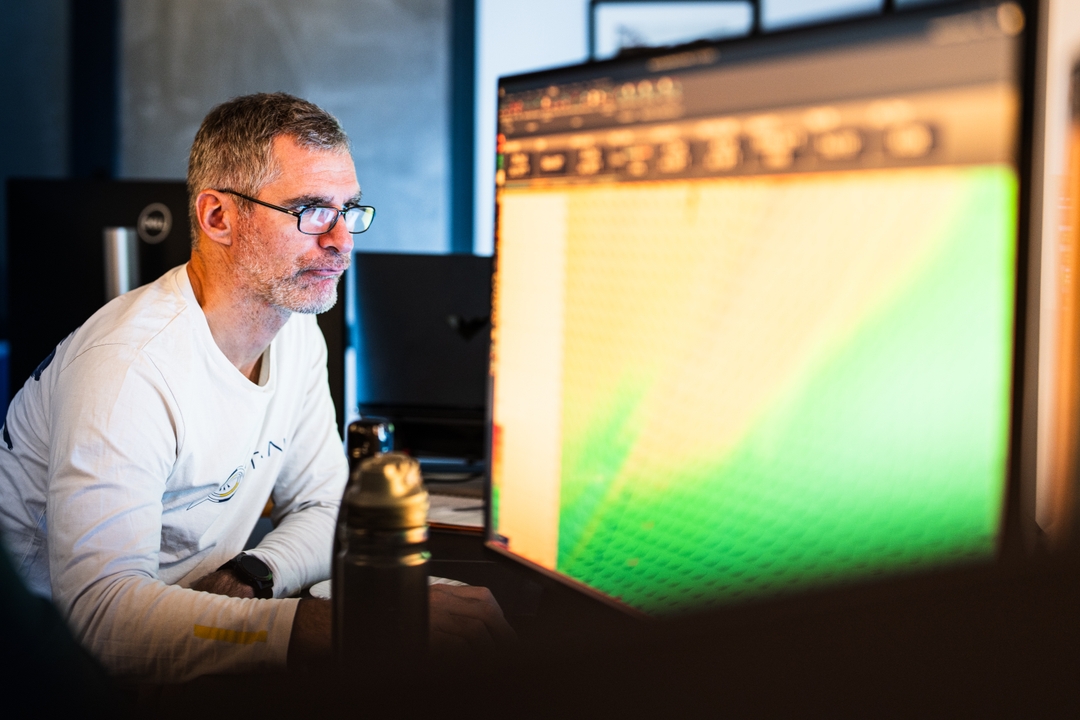
To help him sail the best possible trajectory and monitor his safety 24/7, Charles Caudrelier has shore support from his guardian angels, Erwan Israël and Julien Villion*, an exceptional routing team comprising two talented sailors who are involved in the day-to-day development of the Maxi Edmond de Rothschild. Today, the two men took up residence in their ‘routing house’ in Larmor Plage, Brittany, which will be their headquarters for the next eight days. From there, they will be in direct contact with the skipper of Gitana 18 in what is shaping up to be a rather atypical Route du Rhum, far from the usual sprint to latch onto the trade wind.
A northerly course at full speed in downwind conditions
“The weather models have been matching up for several days. We’re gearing up for a great circle route, namely the shortest course to the West Indies, passing to the north of the Azores. At least as far as the Portuguese archipelago, there will be a massive section of racetrack where we’re able to slip along at high speed, explains Erwan Israël following his review of the morning’s weather files. “For now, this initial section is fairly clear. Beyond the Azores though, there is still too much uncertainty. That said, conditions are pretty favourable for setting sail on the race, with downwind conditions on moderate seas,” continues the router, who doubles as the test pilot and head of performance on Gitana 18.
Making the Azores in two and a half days?
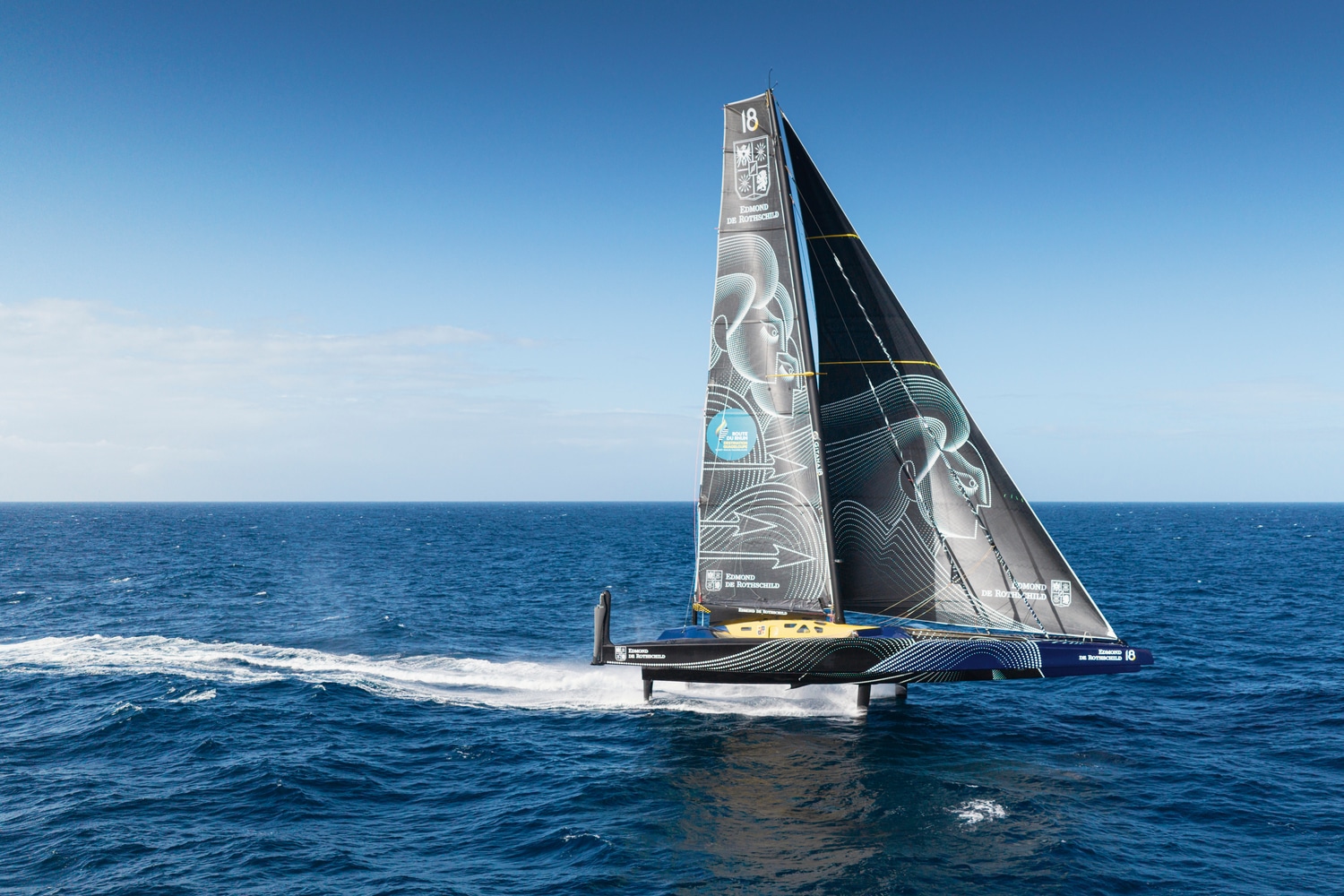
The start, on Sunday 1 November at 01:02 pm, should see the fleet set off in 10/15 knots of NE’ly wind. This particular phase will not be the speediest or the easiest of departures. En route to the first course mark of Cap Fréhel, it may be necessary to put in two gybes before keeping a close eye on the shipping as they head towards the exit from the English Channel and have to negotiate the TSS at Ushant. The further west the large multihulls get, the more the wind is due to build, with a nocturnal gybe on the cards. From there, they will set a course southward, on port tack, for a long downwind sprint in the form of a speed contest as far as the Portuguese islands. “You’d be hard pushed to go any quicker in these conditions! We’re bound to see the Ultims reaching speeds of 35/40 knots and, in just two and half days, the Azores should be astern of us. However, after that, anything could happen from zones of light airs to headwinds to the resurrection of the trade wind. There will be a lot more strategy involved in this second section. Certain routing options predict a finish in Guadeloupe in under six days, but at this stage of the game, given the level of uncertainty at the end of the course, it’s a tough ask to bet on the outcome of that,” continues Erwan.
A land-sea synergy
The good news we can take from this scenario is that neither Charles Caudrelier, nor his rivals, are set to be caught off guard by bad weather. It’s an important and reassuring outlook for the skipper of the Maxi Edmond de Rothschild, who is yet to sail this revolutionary trimaran single-handed for more than three days.
Within this context, the role of the men on shore is crucial. Erwan Israël and Julien Villion will be tasked with keeping their skipper safe, facilitating his work without losing sight of the goal in terms of performance, suggesting specific timing options to launch into a manoeuvre, encouraging him to get some sleep at the appropriates times, responding to any doubts and questions he may have and monitoring the performance of Gitana 18. Charles Caudrelier knows that he can rely on his guardian angels and trusts them implicitly. Nevertheless, it goes without saying that he will be alone in facing the test of speed and handling on his giant boat in the middle of the Atlantic. Indeed, at the end of the day, the final decisions and their execution will be down to him as he battles to make the finish in Guadeloupe in the best possible position on around 6 or 7 November.
*Erwan Israel works full-time for Gitana Team as a sailor and head of performance. He was responsible for routing Charles Caudrelier on Gitana 17 in the previous victorious Route du Rhum. Alongside Julien Villion (and Benjamin Schwartz), he was also at the controls on land during the Arkea Ultim Challenge-Brest, the solo round the world race, which saw Caudrelier triumph.